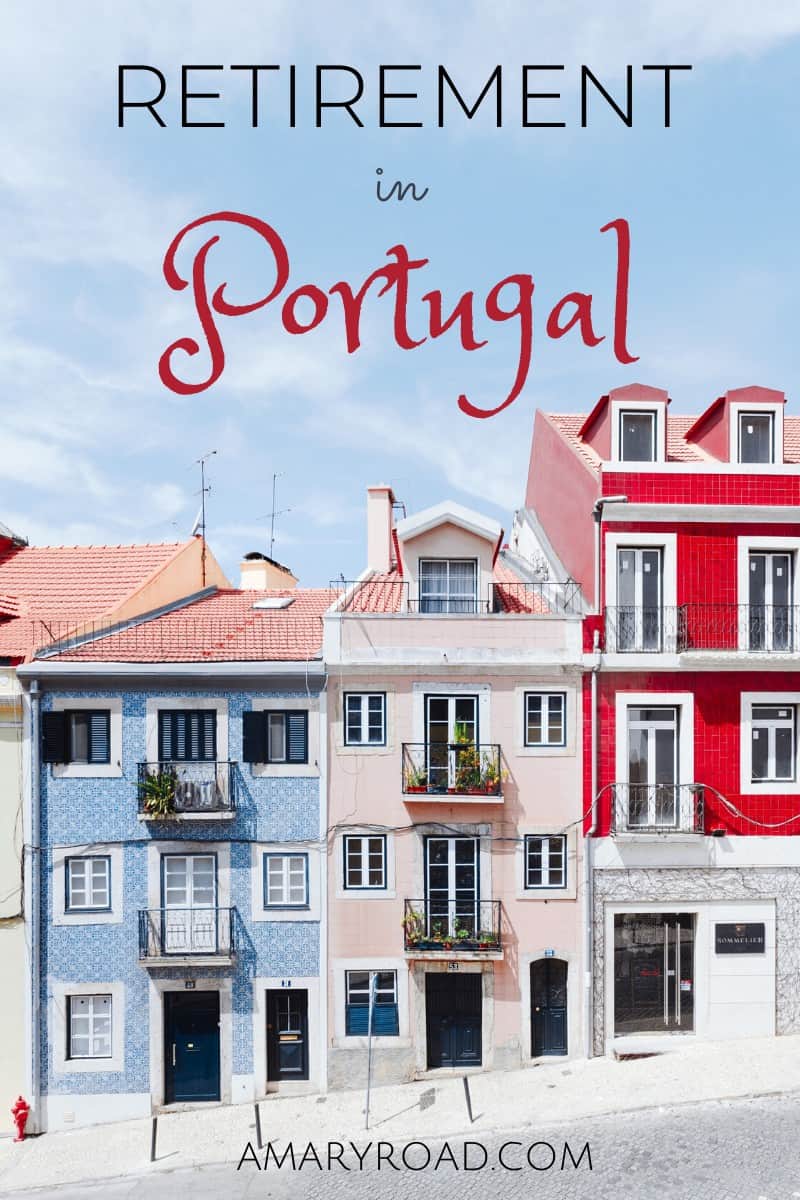
With a temperate, Mediterranean climate year-round, gorgeous coastline, pleasant people, delicious cuisine, and the cheapest cost of living Western Europe, there are few better places to retire than Portugal.

Portugal is almost nine hundred years old, with a distinct culture and a fascinating history. In this Mediterranean country, you can find impressive monuments and culture everywhere, and the food is as diverse and creative as its French and Italian counterparts – reflecting a huge amount of cultural influence brought during the Age of Discovery.
Public services and infrastructure are very good – especially the Public Health System, which is free for all residents. And the country ranks in the top-5 countries of the Global Peace Index, clearly demonstrating that it is one of the safest places in the world.
Getting excited about retiring in Portugal? I don’t blame you. Read on…
This is part of our Retirement Guides series:
– Retire in the Philippines
– Retire in New Zealand
– Retire in Costa Rica
WHAT ARE THE BEST AREAS TO RETIRE IN PORTUGAL?
Most Popular: Algarve
The three most popular areas for foreigners to retire or invest in real estate in Portugal are its two main cities: Lisbon (the capital) and Porto (the second city), and the Algarve region. We’re picking Algarve among these three assuming that you don’t need to be close to a big urban area in your retirement.

Algarve has been, for almost six decades, the main tourist area of Portugal. Ever since the sixties, British people have come to play golf, to spend some days in the seaside and to retire.
In 2019, for the whopping fifth year in a row, the region has won the World Travel Award as Europe’s Leading Beach Destination. The World Travel Awards are the most prestigious awards for world tourism, and are usually called “the Oscars of Tourism.” French and Italians are now also arriving, but you still can find places not hurt by mass tourism or development.
The warm climate (mild even in the winter) and the lovely beaches are just a few of the factors gathering visitors. Those looking for luxury real estate find developments throughout the region. And according to the New York Times, the demand rose nearly 5 percent during the first quarter of 2018.
Known for the beaches, this 125-mile shore region has plenty of diversity. You can find urban beaches like Praia da Rocha (Portimão), vast desert beaches between Faro and Tavira (the Ria Formosa Natural Park), and also the amazing sights of the St. Vincent and Sagres cliffs.
If you fancy living in the countryside, take to the hills and historic villages like Querença or Alte. You’ll be a 30-minute drive from the beach, but you’ll feel in a different world, away from the globalized crowds of Albufeira or Portimão. Gambling is allowed in Portugal; you can find three licensed land-based casinos in Algarve (Portimão, Vilamoura, and Monte Gordo).
The region has its own international airport, the Faro Airport/FAO. Although there are no direct flights from the US, you can pick a direct flight to Lisbon. Then, you can either rent a car, take a bus, or get a quick 45-minute flight to Faro. The A22 highway crosses the region from west to east, connecting to the A-49 Spanish highway at the border.
Up-and-Coming: Oeste
The Oeste (literally, “West”) region of Portugal is becoming the new hub for foreigners to invest in real estate in Portugal. Here there is a combination of three factors: the countryside, the sea and the closeness to Lisbon (an average one hour-drive from the airport). If you long for a quiet place, able to reach the sea by car in a few minutes and the capital city in less than an hour, this will be your choice.

Gastronomy, wines, history, and culture are solid points for the Oeste region. This includes, in its territory and vicinity, plenty of World Heritage monuments (Mafra, Alcobaça, Batalha). The walled streets of Óbidos invite you to feel like you’re in the Middle Ages, and bubble with cultural events throughout the year.
You might consider to set yourself up on the beach, by the Atlantic. The resorts of Óbidos (Praia D’El Rey, Royal Óbidos) await your visit, with their golf courses with a sea view. And Oeste is a famed surfing and beach spot. This is where Garrett McNamara, the giant wave surfer, came in 2011 to beat the record of the biggest surfed wave in history, in the fishing town of Nazaré. However, the town did not need McNamara to become famous, as it is a seaside destination for decades. In fact, in 1948 a little-known photographer named Stanley Kubrick visited and fell in love.
Stroll a little to the south, and you’ll find S. Martinho do Porto, a perfect shell-like bay of very calm waters. Just like Óbidos lagoon, a few miles south. Then you get the great spots for competitive surfing, in Peniche (home for one of the Rip Curl World Pro yearly stages) and Ericeira.
In the towns and villages of the countryside, you can find bargains to invest and to live in, always ensuring that you’re near the A8 highway that takes you to Lisbon. Locals are already welcoming a steady but smooth wave of tourists. After all, this is not the capital – this is the countryside by the capital.
Most Underrated: Alentejo
The southern plains of Portugal are not a tourist hotspot – at least not yet. Local politicians lament the depopulation effects. Industries are few and small scales. Large scale agriculture is still the main economic activity, and it was given a good impulse by the Alqueva Dam and its big lake.

But in Portugal, depopulation doesn’t mean depression. Local town halls provide a minimal number of public jobs, and the existent, active entrepreneurs aren’t going anywhere. The result is that foreigners find small but well-functioning towns, with all kind of services working smoothly. You can be sure that you’ll find a good cafe or restaurant at the end of the road.
There are about 750.000 inhabitants in a territory comprising roughly 12,000 square miles (almost the size of Connecticut, 3.5 million people). Low-density population ensures that you never get rushed for anything. You can cross the 10-mile road between Pavia and Vimieiro and not find a single car.
This is a land of white-washed villages and towns, punctuated with medieval castles, built during Islamic rule (which ceased here in the 13th century) and kept after the Christian Portuguese conquest. Évora, classified as a World Heritage site, is the principal city of the region – but still maintains its medieval walls surrounding the historic center.
The Alqueva lake is now welcoming beachgoers and fans of water sports. For wine lovers, this region is a paradise; it is becoming the leading wine producer of Portugal, and wine tourism is developing along the way. Don’t forget the food, so distinct from Northern Portugal, or the Atlantic beaches (Troia, Porto Covo, Milfontes…)
The low-density population also contributes to the meager prices of real estate. Many youngsters move to Lisbon or abroad, searching for jobs, which ensures that there is more supply than demand.
Finally, the region is quite close to Lisbon. A road trip from the Lisbon airport might take between half an hour and two hours, depending on where you stay. The region is connected to the capital by the A6 (Lisbon-Spain) and A2 (Lisbon-Algarve) highways. If you fancy a tour to neighboring Extremadura in Spain, couldn’t be easier.
Warm climate (similar to Algarve’s), excellent gastronomy, wines and landscapes, and all very inexpensive. Alentejo is a treasure waiting to be discovered.
HOW MUCH MONEY DO I NEED TO RETIRE IN PORTUGAL?
Portugal is Western European quality with South American prices.
The cost of living, overall, is lower than in the United States and other European countries. As the saying goes: Portugal is Western European quality with South American prices.
Real Estate
You’ll find a big difference in real estate prices between the big cities (Lisbon and Porto) and the countryside. The fast growth of tourism and second-home residency meant a steady price increase in these areas. Recent data shows that the square meter value is about USD $2,500 in Lisbon, but the national average is just $1,000.
A two-bedroom apartment could cost between $900 and $1,500/month, aside from both luxury developments and low end, suburban housing. In the countryside, the price could go from $350 to $600.
Monthly Budget
For $500, you can get your monthly groceries comfortably, for two people. This would include utilities: cable, internet and cell phone (around $45, without premium channels); power ($30 to $45); gas ($20 to $30) and water ($15 to $20). A liter of milk is $0,55; 1 kg of pork could come for less than $5. A coffee (Portuguese style, a tiny but powerful cup) is less than $1, just like a beer. The Big Mac menu is not as cheap as you would think (around $6).
A regular Portuguese restaurant gives you a complete meal for $15/person: appetizers, main dish, a bottle of wine, bread, dessert, and coffee.
Groceries and utilities don’t have the same variation between Lisbon or Porto and the countryside as real estate. However, you may conclude that settling in the countryside can be a little cheaper, regarding groceries too. In touristic places of Lisbon, a coffee can cost a little more than $1.10 – and most Portuguese feel that’s too high!
Lately, Portugal clothing market is being overrun by ultracheap products made in Bangladesh. You can get new t-shirts for $3, jeans for $12 and so on. Primark, the European low-cost retailer which has 9 locations in the Northeast, has 7 stores in Portugal alone.
Cars
European roads and streets are tight, and so are the average European cars. Aside from typical American brands with little world reach, like Dodge or Buick, you’ll find all sort of car brands for sale, and a big market for used cars too. A brand new BMW Series 1 is $30,000; the tiny Ford KA+ is only $11,000.
Mind that you’ll find the fuel prices surprisingly high. Gasoline has been floating between $1.40 and $1.70/liter ($4,20 and $4,84/gallon). This could be another reason to go for a smaller, cheaper car, which will need less fuel.
Aside from fuel, some expenses might surprise an American expat. Almost every highway has tolls; processed drinks suffer from a governmental tax to fight obesity. But, overall, the country is a good bargain. Remember that Lisbon, Porto and some Algarve areas (the most “touristic” ones) can be a little more expensive than the rest of the country; hence the opportunity of areas like Alentejo, Oeste and others.
DO YOU NEED A VISA TO RETIRE IN PORTUGAL?
Portugal is a member of the Schengen Area, a group of 26 European countries that abolished their internal borders, almost matching European Union. US citizens do not need to apply to a Schengen VISA to stay up to 90 days. To stay for longer, one should contact the Immigration service, SEF (Serviço de Estrangeiros e Fronteiras), equivalent to the Department of Homeland Security.

The route to citizenship
If you’re a regular, US-born citizen of no Portuguese descent, there are two ways to get Portuguese nationality: marrying a Portuguese national or living in Portugal.
- In the first scenario, you’ll need to be married for three years or longer. Cohabitation for the same period is also valid, although a Portuguese court should recognize it.
- In the second, you’ll need to live in Portugal for six or more years permanently. You will also need to complete a written test certifying that you have sufficient control of the Portuguese language.
Obviously, there are some other requirements to apply for Portuguese nationality. The candidate must be at least 18 years old, not having been sentenced for a crime in Portugal punishable with 3 or more years in prison, and not having been involved in terrorist activities.
How to qualify for residency
You can ask for a residence visa (visto de residência), allowing you to stay up to four months, or two kinds of “normal”, “regular” residence permits:
- Temporary (autorização de residência temporária, ART), valid for one year, renewable for two;
- Permanent (autorização de residência permanente, ARP), renewable after five years or whenever a change occurs in its data.
Family reunions, working, access to the legal system and access to healthcare are some of the rights granted to permanent residents.
SEF will ask you for several documents when you apply to a residence permit. You should schedule a meeting with them beforehand, to avoid queues in the regular service.
Special residency permit #1: Non-Habitual Residency
Aside from the “regular” residency permits, there is a very special one: the non-habitual residency permit (Residente Não Habitual, RNH). The RNH allows foreign citizens to change their tax address to Portugal and get benefits from it.

Through this scheme, if you’re retired, your foreign-based pensions, received in Portugal, will be exempt from taxes.
To apply to the RNH, you cannot have lived in Portugal in the previous five years. One should be willing to stay in Portugal for at least 183 days per year or to own a house, demonstrating he can live in Portugal permanently.
The RNH permit has granted Portugal some criticism from its European Union partners. Some call it an “offshore for people”, like the offshore tax havens for financial movements and capital. Sweden and Finland, two Nordic countries with stringent rules regarding fiscal policy, have denounced their treaties with Portugal regarding double taxation. Due to the RNH, they discovered that their nationals were paying no taxes on their pensions; exempt at home due to the treaty, exempt in Portugal via RNH status.
While climate, security and lower prices are the factors that people usually use to explain the success of the retirement market in Portugal during the last ten years, the RNH is the unsung hero of this success. The program appeared in 2009, and there are currently 30,000 foreign, “non-habitual residents”.
Curious coincidence: in Portugal, the income tax on individuals it’s called IRS (Imposto sobre os Rendimentos das pessoas Singulares). Make no confusion with the American IRS; the Portuguese revenue service it is called Autoridade Tributária e Aduaneira, or Finanças (Finances) in everyday language (pronunce like “fee-nan-sas”).
Special residency permit #2: The Golden Visa
The Golden Visa is a residency permit given to people investing at least €500,000 in real estate in Portugal.
The official name is “Residency Permit for Investment Activity” (Autorização de Residência para Atividade de Investimento, ARI). The candidate will be allowed to enter in Portugal without a residency visa, circulate in the Schengen Area and bring the family. He could also apply to a permanent residency permit or Portuguese nationality, according to the law. You should be in Portugal 7 days per year in the first year of permit and 14 days per year subsequently.
There are other ways to invest through ARI, like capital transfer of $1,000,000, or creating a minimum of 10 jobs in Portugal. But investing in real estate is by far the most chosen way by candidates. Chinese are the most frequent candidates to Portuguese Golden Visas.
Legal system
Once you get a residency permit, you’ll have the same legal rights as a Portuguese citizen. Portugal is a fully-fledged democracy and a member of the European Union, based on the principles of the rule of law, civil liberties and Human Rights. You will feel no particular problems regarding this.
The Portuguese legal system, as the whole Continental Europe, follows the Roman Law tradition, falling in the Civil Law system, unlike the Common Law followed in America. However, and apart from the almost inexistent role of a jury, these differences are mostly felt by lawyers, rather than by citizens seeking justice. You’ll always have the right to an attorney.
IS REAL ESTATE EXPENSIVE IN PORTUGAL?
As we mentioned above, the local property market displays a significant value difference between Lisbon (and also Porto) and the rest of the country. Throughout the country, you’ll find that there is way more offer to buy than to rent. The current macroeconomic policy of the European Central Bank is stimulating owners and developers to sell.

Choosing a real estate agency (or agent) is the first step to find a property. You could buy or rent on your own, but a good agent has the local knowledge of the market (and regulations) that a foreigner lacks. There is no difference between agents, brokers, or realtors; you’ll find a single category of real estate companies, which can have a single agent or a team.
Beware of non-licensed agents; always check if they have an official AMI number with the APEMIP, the Portuguese NAR. Remax, ERA, and Century21 are in the market.
If you’re thinking about a long-term investment, buying will be wiser. Ask your agent for advice, but don’t forget to check online for properties yourself in web portals like Casa Sapo, Imovirtual, Idealista, and OLX (a Craigslist-like portal present in 45 countries). Portals show both properties to rent and to buy.
HOW MUCH DOES HEALTH INSURANCE COST?
The Portuguese government maintains a public, national Health Service, in line with the European welfare tradition regarding this matter. The service is free; aside from minor taxes, which one can pay for consults or Urgency services (never above $22). Even major surgeries are free!
Once you have a residence permit, you can benefit from the service like a national. To register, US citizens need a document of the Immigration Service (SEF) and show it in their local Family Health Unit (USF). As the service is free, it is recommended that you sign up. It’s a cheap way to keep an eye on your general health and perform regular clinical pathology tests.
However, the public system has its flaws and limitations (efficiency, budget, etc.). You may find that your local USF (“Family Health Unit”, a local government-owned medical facility for basic care) is too crowded. MRIs’ and CT scans are very hard to get. You may need dental medicine, a specialty almost nonexistent in the public service. Or maybe you need a specialty that your local hospital is not providing.
This is especially true in Algarve. In spite of being a significant tourist and second-home market, Algarve still lacks a large, central, and well-provided public hospital like the ones of Lisbon, Porto, and Coimbra.
Private services are the alternative. Portugal is going through a period of expansion of private hospitals and insurance. You’ll find both domestic and well-known international insurers, like Allianz and Zurich, in the market. You may get partial insurance (for dental medicine, vision, and or other specialties lacking in the public system) or full coverage. Check the terms and conditions carefully, as rates may increase after a certain age.
The rates can vary wildly. Even searching online, you may find it difficult to get accurate prices before filling a questionnaire. An alternative is to look for help, like the one provided by AFPOP – Portugal Foreign Residents Association, which can get you advice and discounts. AFPOP members affirm they can get full coverage (with an international insurer) for about $660/year.
Elderly care services are also booming, in line with the aging trend of the Portuguese population. It is possible to find full-time (24 hours/day) home support (including hygiene and accompanying) from $880/month; a good elderly home, with more customized service, would start from $1,100. There is plenty of offer below these prices, but usually, it relies on unlicensed professionals.
WHAT ARE TAXES LIKE FOR RETIREES?
The taxes you’ll be responsible for will depend on the kind of investment you make in the country. As discussed above, by getting a non-habitual residency permit (RNH), you may get a flat tax fee or an exemption. The personal income tax is called IRS (it’s the “coincidence,” allowing confusion with the American IRS, also discussed above).
Portuguese banking technology levels are state-of-the-art. You can open a bank account online: fill your personal data and then go to the nearest branch just to confirm and sign. Some banks might allow you to do everything online. Eventually, you’ll find out that most Portuguese still don’t use this kind of accounts. But that is due to the usual reasons for people using what they already know. 100% online banking is used by millennials, executives, urbanites, and other early-adopters.
If you buy a house, you’ll need to pay a yearly property tax (IMI, Imposto Municipal sobre Imóveis). It is decided at a local level, by the municipalities (Câmara Municipal), but payment is made to the tax authority (Autoridade Tributária). It varies between 0.30% and 0.45% of the amount that the tax authority considers your property is worth (something you can contest if you find it too high).
If you buy a car, you’ll have to pay the yearly IUC (Imposto Único de Circulação), calculated by the tax authority according to the value and capabilities of it.
If you set up a company in Portugal, you’ll pay corporate tax (IRC, Imposto sobre o Rendimento das Pessoas Coletivas). Apart from some exceptions, most companies pay 23.5% (including a municipal corporate tax, usually of 1.5%)
Portugal is not the most competitive country in terms of taxes (unless you get the non-habitual residency permit, as we made clear.) Due to the 2011 bailout, amid the Great Recession and the Eurozone crisis, the country has had to apply a hefty dose of taxation on economic activities, especially on consumption. That’s why fuel seems so expensive, compared with the US. Portugal’s VAT or sales tax (named “IVA”) is 23%, which is above the EU average (although several exemptions goods have reduced IVA).
But taxes on consumption are not felt by the user unless the end price gets too high. And, as we mentioned above, Portugal is the cheapest country in Western Europe – even with high consumption taxation.
The main tax tip is to apply to the non-habitual residency permit. While buying a house, you could check the IMI (property tax) collected by the municipality where you’re buying, although the tax rates end up being very similar throughout the country, as we said above.
Funny note: the Portuguese word for tax is “imposto,” which also means “imposed.” It reveals the nature of it – no one would pay voluntarily; taxes must be “imposed.”
HOW SAFE IS PORTUGAL?
According to the Global Peace Index, Portugal is one of the five most peaceful countries in the World. The World Economic Forum ranks it as the 9th safest country, according to its Travel & Tourism Competitiveness Report 2019. InterNations, the world expat community, developed a 20.000 people (more than 170 countries and nationalities) survey which deemed Portugal as the 8th safest country.
If you move to Portugal, learn to read Portuguese and start reading newspapers in cafes, you’ll find the omnipresent “Correio da Manhã,” the national sensationalist tabloid. Every day there is crime news – which is inevitable because, in a country of 10 million inhabitants, crimes are happening every day. But you’ll quickly find that the country is as safe as it looks. No mass shootings. No police officers dead in the line of duty.
The problematic areas are the impoverished suburbs of Lisbon, which foreigners should avoid – not much to do or see there, anyway. The same happens in Porto, on a smaller scale. In downtown Lisbon, crowded with tourists, beware with pickpocketing.
Elsewhere in the country, follow general rules of common sense. Avoid to exhibit wealth and close the door. Get involved with the local community (face to face and social media) so that you can stay about local precautions (for instance, if a group of bandits keeps invading homes before they’re caught).
HOW EASY IS IT TO GET AROUND?
Local infrastructure is more developed than one would think. Membership of the European Union allowed Portuguese authorities (both at a central and local level) to improve roads and other public structures; there is no shortage of public water supply, electricity, or mobile network throughout the country (especially around the metropolitan areas and Algarve). Portugal has one of the best highway networks in Europe; however, as lovely as Lisbon’s trams are, in general train transportation is below average compared to the rest of Europe.
Driving is smooth throughout the country. Traffic jams in Lisbon are necessarily small, compared with what happens in large American cities. Portuguese drivers are a little more polite in the North than in Lisbon, but general adherence to the rules has improved over the years (and road mortality decreased).
American driver’s licenses are valid for six months. After that, you should exchange for a Portuguese one at IMT, the Portuguese DMV. It won’t be necessary to do a new driving exam, just the usual bureaucracy.
WHAT RECREATION DOES PORTUGAL OFFER?
Leisure and activities can be quite different between big cities and the countryside. In Lisbon and Porto you could expect to find everything you would in a big world city. If you’re all for sports (watching or practicing), you should try to enjoy soccer and visit the 50,000 seat stadiums of the nation’s larger clubs.
You could also practice every kind of sport, from go-karting to surf. In the countryside, there are apparently fewer options, but in most municipalities, you can find a public swimming pool, buy a good bike for cheap or get mates for traditional games (cards and others).
HOW CAN I SHIP MY STUFF?
Regarding your personal goods, several companies can serve you (sometimes involving a shipment to the Netherlands and then a truck transport to Portugal). But depending on your needs, you might consider making an investment locally, as it could end up being both cheaper and easier. For furniture, for example, there are 5 IKEA stores in Portugal (2 in Lisbon, 2 in the North and 1 in Algarve).
TAP Air Portugal and Azores Airlines are both members of the IATA (International Air Transport Association), like most American companies. The main rules regarding pet shipping are the ones designed by the IATA, as the standard of international aviation. You should check each company specific conditions (prices, guidelines, etc.).
ARE THERE RETIREMENT COMMUNITIES IN PORTUGAL?
Yes, and the Portuguese are naturally welcoming of foreigners. As in every country, you’ll seldom find (in the local media) social or political negative references to immigration. (Although way less intense than in other European countries, as immigration from Africa is not that influent, and from the Middle East is non-existent). For expats coming from Northern Europe and North America, nothing of this applies. People are aware that foreigners from these countries are there to enjoy the country. They are universally welcomed.
You won’t have much trouble getting by in English. Keep in mind that the percentage of people able to communicate in English is lower outside Lisbon, Porto, and Algarve (and especially in rural areas). It is also lower with people above 50 years old. But if you find youngsters, it should be easier.
The Portuguese appreciate expats, and you can find English speakers everywhere. In fact, Portuguese prefer to watch American movies with subtitles, rather than dubbed . It has been like this ever since TV transmissions started. Aside from school, this also helps the country to have a higher understanding of English than others, namely Spain.
The most efficient way to find expats it’s still the internet. US communities are too small to gather in dedicated social clubs; only the British do that, and only in Algarve. However, the “best” way (even if not the efficientest) is going around the most frequented restaurants, cafes, and pubs. Foreigners tend to go to similar places – genuine, traditional Portuguese restaurants of good quality.
FINAL THOUGHTS
In terms of finding a place to retire, it doesn’t get a whole lot better than Portugal.
The health care system is top-notch, the people are friendly, the food is wonderful, and there is no shortage of places to explore. Plus, the cost of living is low, and the non-habitual residency permit is one of the most generous legal tax loopholes in the world. The Portuguese are accomodating and want you to know you are welcome. Will you join them?
ARE YOU ON PINTEREST? SAVE THIS FOR READING LATER